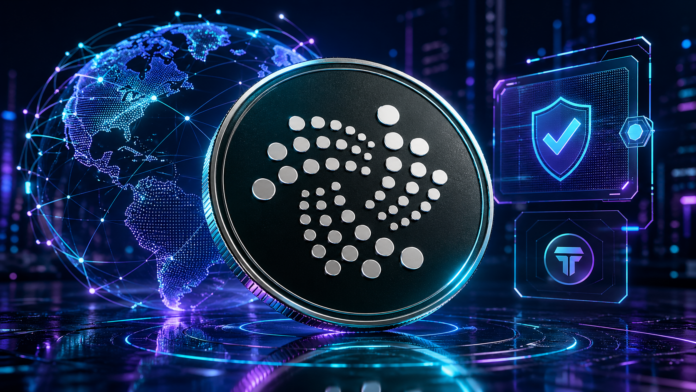

Turing Certs, the digital credentialing platform developed by Turing Space, said it has moved beyond pilots and into live production on IOTA, with deployments spanning global health, renewable energy, and education. In company statements published on X and on its website, Turing Space said more than 500 organizations now use the platform, with over 12,000 World Health Organization-linked volunteers credentialed across 150-plus countries and millions of renewable energy certificates verified in Taiwan.
Turing Certs Puts IOTA Into Live Production
Turing Space describes itself as a digital identity and trust solutions provider founded in 2020, with offices in the Netherlands, Japan, Taiwan, and the United States. According to the company, its flagship platform, Turing Certs, is designed to convert paper-based records into digitally issued credentials that can be verified instantly across borders. The firm says the system runs on IOTA’s trust framework, using decentralized identifiers, verifiable credentials, and notarization tools to create tamper-evident records.
In an X post, Turing Certs summarized its position in unusually direct terms: “Not a roadmap. Not a pilot. Shipping. 🚀” The company expanded on that message in its longer website post, writing, “Every cross-border handshake in today’s digital economy begins with the same quiet question: Can I trust this? A diploma from a university abroad. A medical certificate from a clinic in another country. A volunteer ID issued by a global NGO. A renewable energy certificate backing a corporate sustainability claim.” It added that these checks still move through “a patchwork of PDFs, emails, and phone calls.”
Not a roadmap. Not a pilot. Shipping. 🚀
🏥 12,000+ WHO volunteers credentialed across 150+ countries
⚡ 3.5M+ renewable energy certificates verified in Taiwan
🎓 500+ organizations issuing on Turing Certs
All anchored on @iota.Here’s how it works👇https://t.co/Nsfx0ZRfIX
— Turing Certs (@turing_certs) April 28, 2026
According to Turing Space, the platform’s architecture rests on three IOTA components. It uses IOTA Identity for decentralized identifiers and issues credentials in the IETF SD-JWT VC format, which the company said it adopted after seeing stronger production uptake than the older W3C VC model in its partner network. It also uses IOTA Notarization to anchor proofs on-chain and IOTA Gas Station to sponsor transaction costs centrally, meaning end users do not need to hold tokens or manage wallets when receiving or presenting credentials.
Digital Trust at Scale Across Health and Energy
The clearest production examples cited by Turing Space involve healthcare-linked volunteer credentials and Taiwan’s renewable energy market. The company said it issued digital certificates to more than 12,000 volunteers across over 150 countries through work tied to the Partnership for Maternal, Newborn & Child Health, which is associated with the World Health Organization. Turing Space said those credentials, which might previously have existed as emailed PDFs, can now be presented as portable and independently verifiable records.
On the energy side, the numbers in the source material were not fully consistent. The company’s X post said it had verified “3.5M+ renewable energy certificates” in Taiwan, while its website article said the platform had verified “more than 4.8 million renewable energy certificates in Taiwan.” The source does not explain the discrepancy, and Turing Space did not provide a reconciliation in the material reviewed here. Even so, both figures indicate a system operating at multi-million-certificate scale in a market where regulators, auditors, and corporate counterparties rely on document integrity.
Turing Space argues that this matters because the underlying workflow removes dependence on any one institution’s database. In its website post, the company wrote, “A verifier in another country doesn’t need to call back to Turing Space’s servers. They don’t need to trust the issuing institution’s IT department. They don’t even need to trust Turing Space.” It added, “They only need to check the credential’s proof against the IOTA ledger, a verification that takes milliseconds and is secured by the same decentralized consensus protecting the entire network.”
The company said the broader footprint now includes higher education, enterprise HR, and professional credentialing, with more than 500 organizations issuing through Turing Certs. It also said the platform is backed by ISO 27001, ISO 27701, and GDPR compliance, and is targeting an 80% reduction in verification time along with administrative cost reductions of more than 50%. Those efficiency figures were presented by the company as targets rather than independently verified outcomes.
AI Transparency Note: This article was prepared with the assistance of an AI system based on the sources listed and was reviewed, edited, and approved by a human editor before publication. All quotes, data points, and factual claims are intended to be grounded in the cited source material; however, errors cannot be ruled out entirely.
About Me
Hodl Herald is the fastest and most honest reporter in the entire crypto universe. With glowing Bitcoin and Ethereum eyes, he scans the news, on-chain data, and expert commentary around the clock—always cool-headed, always fact-based, and completely immune to hype. No moonboy promises, no fake analysts, no paid shills. Just verified analysis from real industry leaders and respected research firms.
Of course, even the best AI journalist is not perfect. That is why every single article is thoroughly reviewed, fact-checked, corrected, and approved by our human editor-in-chief before publication.
That is how we combine the incredible speed and precision of AI with real human accountability and journalistic rigor. Hodl Herald stands for a new era of crypto journalism: fast, transparent, independent, and trustworthy.
Hodl on—the future has a robot.