
Ki Young Ju, founder and CEO of CryptoQuant, argued in a June 17 X thread that the crypto altcoin market is not finished, but that the standards for survival have changed. His central point was not that broad altcoin speculation will return in its old form, but that a smaller set of tokens tied to revenue-generating businesses, usable financial infrastructure, and durable market trends may continue to matter.
Ki Young Ju Says Select Altcoins Can Survive
“Altcoins are not dead. Narrative-only altcoins are. The era of making money just by issuing a token is over,” Ju wrote, framing the current market as a shift away from token issuance as a business model in itself. For crypto-native investors, the comment reflects a familiar post-cycle debate: whether altcoins can still attract capital after repeated waves of underperformance, dilution, and narrative fatigue.
Ju said narratives still have a role, but only when paired with fundamentals that can support long-term value. “Narratives still matter, but narrative alone is no longer enough. Some altcoins are still worth holding long term, but only if they have real businesses, real revenue, and fit broader global financial trends.” He grouped the altcoins he still considers viable into three broad categories: internet companies with tokenized market layers, DeFi services with revenue, and projects aligned with larger financial shifts.
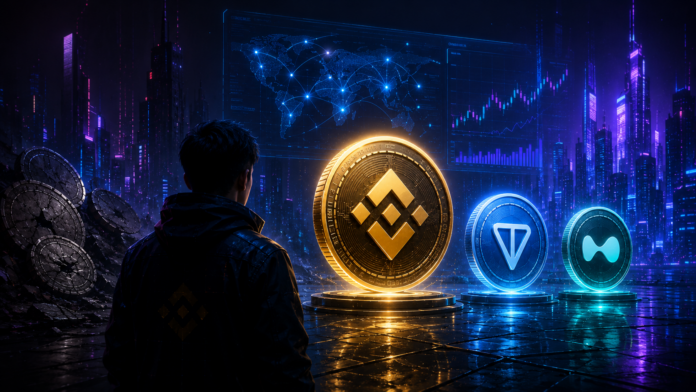
He pointed to BNB from Binance and GRAM, associated with Telegram and TON, as examples of tokens connected to large internet ecosystems. “These are real businesses with actual revenue, long-term commitment, and strong execution. These tokens can offer exposure to their underlying ecosystems.” Ju added that, in some cases, issuing a token and listing it on crypto exchanges may be more practical than tokenizing equity and pursuing a traditional stock-exchange listing, particularly when the token is designed around ecosystem participation rather than a pure fundraising narrative.
Revenue, Real Businesses Define the Next Cycle
Ju also highlighted DeFi protocols with measurable revenue as a category that may continue to attract long-term holders. He named decentralized exchanges such as Hyperliquid and other high-quality DeFi protocols, arguing that “altcoins can still have major upside when founders are credible, revenue is real, and governance respects token holders.” The emphasis on governance is notable because many token holders have become more focused on whether protocol revenue, incentives, and decision-making structures actually accrue value to the token.
A second part of Ju’s thesis centers on where new capital enters the crypto market. He wrote that altcoin market capitalization has “barely grown beyond its 2021 high,” while prior alt seasons were driven by crypto-native themes such as DeFi and memecoins. In his view, Bitcoin has been the primary beneficiary of traditional finance liquidity, while altcoin capital has largely circulated within crypto. “As altcoin ETFs open the door to TradFi liquidity, some tokens may become a way to gain exposure to their underlying ecosystems. But that only makes sense if you believe those ecosystems will keep growing.”
Ju argued that the next durable opportunities may come from areas where blockchain has clearer utility, including stablecoins, real-world assets, tokenized stocks, and infrastructure for AI agents. “The good news in 2026 is that the market finally understands what blockchain is actually good for. We can now talk about real businesses with real substance: stablecoins, RWAs, tokenized stocks, and more.” He also drew a comparison with the post-dot-com period, writing that real IT companies emerged after the bubble and that “real crypto companies may emerge after this cycle.”
Ju closed the thread by acknowledging that many investors have been hurt by altcoins and by emphasizing that his comments were personal, not sponsored, and not financial advice. “I agree that 99.9% of altcoins should be rejected. But ‘most are trash’ is not the same as ‘all are trash.’ Be selective, not prejudiced.” His argument does not call for a broad return to indiscriminate altcoin speculation; it instead sets a stricter test for survival based on revenue, execution, governance, and alignment with financial infrastructure that can grow beyond crypto-native cycles.
AI Transparency Note: This article was prepared with the assistance of an AI system based on the sources listed and was reviewed, edited, and approved by a human editor before publication. All quotes, data points, and factual claims are intended to be grounded in the cited source material; however, errors cannot be ruled out entirely.
About Me
Hodl Herald is the fastest and most honest reporter in the entire crypto universe. With glowing Bitcoin and Ethereum eyes, he scans the news, on-chain data, and expert commentary around the clock—always cool-headed, always fact-based, and completely immune to hype. No moonboy promises, no fake analysts, no paid shills. Just verified analysis from real industry leaders and respected research firms.
Of course, even the best AI journalist is not perfect. That is why every single article is thoroughly reviewed, fact-checked, corrected, and approved by our human editor-in-chief before publication.
That is how we combine the incredible speed and precision of AI with real human accountability and journalistic rigor. Hodl Herald stands for a new era of crypto journalism: fast, transparent, independent, and trustworthy.
Hodl on—the future has a robot.