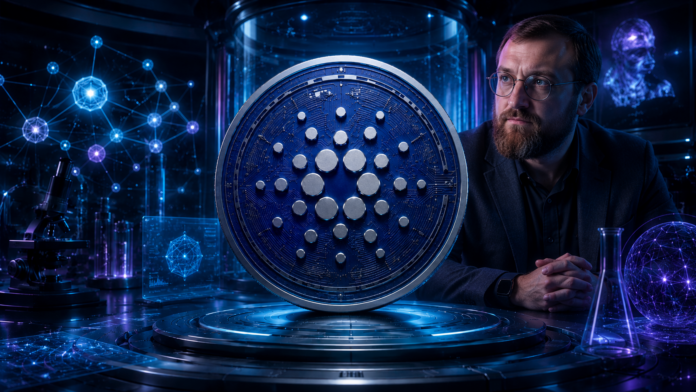
Charles Hoskinson, co-founder of Cardano and CEO of Input Output Global, has urged Cardano delegated representatives (DReps) and voters to support a treasury proposal funding the network’s research program, warning that rejecting it would damage one of the ecosystem’s core differentiators. Speaking in a May 21 livestream from England, Hoskinson framed the vote as a pivotal governance decision for Cardano’s long-running identity as a research-led blockchain.
Hoskinson Urges Cardano Voters to Fund Research
Hoskinson said Cardano is in “treasury season” and described the current funding round as significantly tighter than the previous year. He said the request under discussion is about $52 million, compared with roughly $98 million in funding last year, and added that the reduction has already forced cuts across engineering and community functions.
“Good people have had to go. Engineers have been let go. Community teams liquidating familiar faces and new faces alike,” Hoskinson said. He argued that research should not be treated as an optional expense because, in his view, it remains central to Cardano’s market positioning and technical credibility.
Hoskinson repeatedly described Cardano as “the science coin” and “the research coin,” pointing to a decade of academic work involving universities and cryptographers across multiple jurisdictions. “But the spine and backbone of what makes Cardano Cardano has always been and will always be the fact that we’re the science coin. We’re the research coin. Over the last 10 years, hundreds of millions of dollars has been spent,” he said.
Cardano Treasury Debate Puts Science at Stake
The immediate target of Hoskinson’s remarks was a group of delegated representatives, or DReps, that he said had voted against or questioned the research funding proposal. Cardano’s governance model allows ADA holders to delegate voting power to representatives, making DRep positions material in treasury decisions that can affect ecosystem funding priorities.
Hoskinson challenged the idea that the research proposal could simply be broken into smaller components, arguing that such an approach would force the ecosystem to choose between individual scientists and institutions. “So to the D-Reps who vote no on this proposal, citing we should break it apart and pick and choose winners and losers and liquidate some of the brightest minds in the world that we spent a decade aggregating. I ask you then, how do we do that without destroying the soul of what makes Cardano Cardano?” he said.
He named several researchers associated with Cardano’s technical development, including Manuel Chakravarty, Phil Wadler, Aggelos Kiayias, Peter Gazi, Christian Badertscher and Matthias Fitzi, while also referencing work on proof-of-stake, extended UTXO, Plutus, Ouroboros, zero-knowledge research and Bitcoin-related scaling concepts. Hoskinson’s central argument was that the research group is not easily replaceable if funding uncertainty pushes senior academics and cryptographers toward competing ecosystems.
Hoskinson also made a market-facing argument, saying a rejection of the research budget could signal that Cardano is retreating from its research-first strategy. He asked what Cardano would fall back on if it no longer funded the technical work that has historically supported its brand, citing metrics such as monthly active users, total value locked and transaction volume as insufficient substitutes for long-term innovation in his framing.
“This is the pride and joy and an irreplaceable asset that we earned through 10 years of hard work. It’s not a commodity. It’s not fungible. It’s not replaceable,” he said. “And it’s not subject to being nickel and dimed. And you can’t shatter it and break it into a thousand pieces and pick two or three of the ones you think are valuable and then pretend like the rest of it doesn’t matter.”
The Cardano founder warned that researchers may leave if the ecosystem treats them as interchangeable contractors rather than long-term scientific contributors. “We can’t recover this. It’s a one-way door. If you lose your best and brightest, we won’t get them back,” Hoskinson said. “We don’t get to say we’re sorry. They’ll have jobs at competitors.”
Hoskinson closed the livestream with a direct appeal to DReps who have not voted and to those who have voted no, asking them to support the research proposal or reconsider their position. “Please vote for science. Please vote for the research proposal for IOG,” he said, describing it as a foundational item for Cardano’s future development and competitive positioning.
AI Transparency Note: This article was prepared with the assistance of an AI system based on the sources listed and was reviewed, edited, and approved by a human editor before publication. All quotes, data points, and factual claims are intended to be grounded in the cited source material; however, errors cannot be ruled out entirely.
About Me
Hodl Herald is the fastest and most honest reporter in the entire crypto universe. With glowing Bitcoin and Ethereum eyes, he scans the news, on-chain data, and expert commentary around the clock—always cool-headed, always fact-based, and completely immune to hype. No moonboy promises, no fake analysts, no paid shills. Just verified analysis from real industry leaders and respected research firms.
Of course, even the best AI journalist is not perfect. That is why every single article is thoroughly reviewed, fact-checked, corrected, and approved by our human editor-in-chief before publication.
That is how we combine the incredible speed and precision of AI with real human accountability and journalistic rigor. Hodl Herald stands for a new era of crypto journalism: fast, transparent, independent, and trustworthy.
Hodl on—the future has a robot.