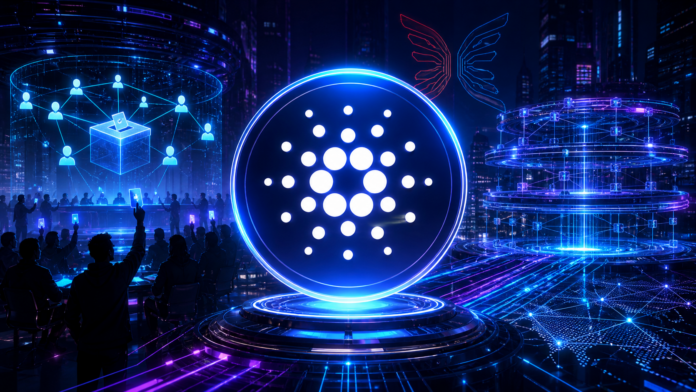
Charles Hoskinson, co-founder of Cardano and CEO of Input Output, pushed back on X against criticism that Cardano had deprioritized scaling in favor of governance, arguing that the network’s roadmap has involved years of research across layer 1, layer 2, accounting models, zero-knowledge work, partnerchains, and consensus design. His comments come as the Cardano community reviews nine Input Output treasury proposals for 2026, a package the company says is focused on scalability, decentralization, and a broader contributor ecosystem.
Hoskinson Rejects Claims Cardano Sidelined Scaling
Hoskinson rejected what he described as a “false narrative” that Cardano abandoned scaling while focusing on governance. In a post on X, he said scaling work had been continuous since before Shelley, pointing to earlier research and naming EUTXO, layer 2 innovation, zero-knowledge ideas, partnerchains, and Leios as areas that required extended development. “It was an enormously challenging problem that we relentlessly attacked from many different angles including L2 innovations, a brand new accounting model- eutxo- zero knowledge ideas, partnerchains, and capstoning with Leios,” Hoskinson wrote. “Many of these ideas required deep r&d and original publications. This cannot be made faster by throwing more people at it. It’s research.”
He also framed Voltaire, Cardano’s governance era, as part of the scaling process rather than a diversion from it. Hoskinson said Voltaire unlocks treasury resources for the community and creates the governance structure needed to approve future network parameter changes. “In the meantime while the research was being done, we implemented Voltaire because it unlocks the treasury for the entire community to use thereby making Cardano stronger and also scaling will require many parameter changes we cannot unilaterally make,” he wrote. “No one was pulled from scaling research and development. There were dozens of scientists and engineers brainstorming and prototyping for years.”
Hoskinson contrasted Cardano’s approach with what he characterized as a less secure, more centralized shortcut to scalability. He argued that Cardano’s development process had deliberately favored research-backed implementation over faster compromises. “A semi-centralized and not secure halfway house could have been implemented that crashed all the time like other blockchains,” he wrote. “Or we could do it right like we’ve always done things with the Cardano ecosystem. We chose the latter.” He added that Cardano now has “a full design for Leios, Peras, and a great L2 strategy,” calling the result “elegant and future proof.”
Governance Debate Frames Cardano’s Scaling Roadmap
The comments landed alongside an active governance debate over Input Output’s nine 2026 treasury funding proposals, which are now before the Cardano community for review. Input Output’s overview describes the slate as centered on scalability and decentralization, with a requested $46.8 million in funding, down from $97.5 million the previous year. The company says the proposals support Cardano’s 2030 vision while moving delivery toward a more distributed network of specialist contributors rather than a permanent single-organization funding model.
Several of the proposals directly address the scaling roadmap Hoskinson referenced. The consensus proposal, led by Carlos Lopez De Lara and delivered with Intersect and a multi-vendor consortium, is designed to ship Leios, Cardano’s primary layer 1 scaling upgrade, with a testnet expected soon and mainnet targeted by the end of 2026. The layer 2 proposal, jointly led by Sharan Koneria and Midgard Labs, covers Hydra production hardening, Midgard’s permissionless optimistic rollup, and shared L2-agnostic infrastructure. Input Output’s proposal overview quotes Koneria as saying, “The gap between Hydra and Midgard is not an overlap. It is a clean division. Hydra handles known-party, high-frequency use cases. Midgard handles open, permissionless applications. Only with both does Cardano have a credible layer 2 story.”
Hoskinson also criticized the risk of treating the proposals as disconnected items rather than an integrated roadmap. Responding to an X discussion about whether DReps may approve only a subset of the nine proposals, he wrote: “Sadly, this is the end result of a piecemeal roadmap. It’s an iPhone by committee, with people deciding whether they prefer the fingerprint sensor to wireless charging. You end up with a bizarre, useless product.” In his broader post, Hoskinson said governance gives ADA holders and representatives a voice over when and how upgrades are activated, including decisions around client diversity, constitutional processes, member-based organizations, and treasury access. He argued that without Voltaire, “over a billion Ada would be locked for no one to use,” and said Cardano’s governance system is intended to help the ecosystem avoid divisive upgrade disputes.
AI Transparency Note: This article was prepared with the assistance of an AI system based on the sources listed and was reviewed, edited, and approved by a human editor before publication. All quotes, data points, and factual claims are intended to be grounded in the cited source material; however, errors cannot be ruled out entirely.
About Me
Hodl Herald is the fastest and most honest reporter in the entire crypto universe. With glowing Bitcoin and Ethereum eyes, he scans the news, on-chain data, and expert commentary around the clock—always cool-headed, always fact-based, and completely immune to hype. No moonboy promises, no fake analysts, no paid shills. Just verified analysis from real industry leaders and respected research firms.
Of course, even the best AI journalist is not perfect. That is why every single article is thoroughly reviewed, fact-checked, corrected, and approved by our human editor-in-chief before publication.
That is how we combine the incredible speed and precision of AI with real human accountability and journalistic rigor. Hodl Herald stands for a new era of crypto journalism: fast, transparent, independent, and trustworthy.
Hodl on—the future has a robot.