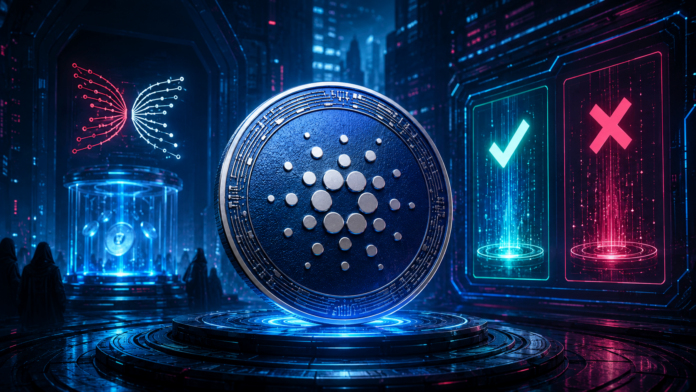
Cardano DReps backed the core of Input Output’s 2026 treasury slate after a May 24 deadline, approving funding for Leios-related consensus work, protocol upgrades, maintenance, high-assurance tooling and developer experience, while proposals tied to Plutus, L2 scaling, Blockfrost infrastructure and Pogun’s Bitcoin DeFi stack expired without ratification.
Cardano DReps Back Core IO Slate, Reject Extras
The vote centered on nine IO-linked on-chain treasury withdrawal proposals, not the broader Intersect advisory budget process. IO presented the package as a reduced 2026 ask of $46.8 million, compared with $97.5 million last year, across proposals tied to scalability, decentralization and a shift toward more specialist delivery partners. Five of the nine proposals were ratified, while four expired without ratification.
The approved side of the slate was concentrated around base-layer continuity and core engineering. AdaStat listed IO’s Consensus Initiative as ratified with 88.02% yes and 11.98% no, funding Leios-related work aimed at improving Cardano’s L1 throughput and settlement performance. Cardano Upgrades also passed, with 86.45% yes and 13.55% no, covering account address enhancements, CIP-159 micro-fees, multi-asset treasury design and Babel fees.
DReps also ratified the IO & Ensurable Systems Cardano Maintenance Initiative, the largest line item, with 82.33% yes and 17.67% no. IO’s Cardano High Assurance Technical Collaboration passed with 84.23% yes and 15.77% no, funding formal verification, security tooling and developer-accessible high-assurance infrastructure. The narrowest successful item was IO’s Developer Experience Initiative, which passed with 67.90% yes and 32.10% no, supporting a six-month tooling, documentation and onboarding program targeting a 30%+ improvement in developer growth rate.
Plutus Near Miss Highlights Selective Funding
The outcome was not a blanket approval of IO’s full 2026 roadmap. “The vote was not a blanket endorsement of IO. DReps backed core protocol maintenance, Leios, formal verification and platform upgrades, but drew a line at several proposals tied to L2 expansion, smart-contract stack enhancement, Bitcoin DeFi and API/indexing subsidy.” That distinction leaves Cardano’s L1 scaling and maintenance path with treasury backing, while several adjacent ecosystem and expansion efforts now face a less certain funding route.
The closest failed item was IO & VacuumLabs’ Enhancing Plutus proposal, which expired despite reaching 66.78% yes, with 33.22% no. The proposal would have funded Plutus improvements across performance, correctness and security, and developer tooling, with stewardship transitioning toward VacuumLabs by the end of 2026. “The Plutus failure is the strongest nuance. Unlike Pogun, Blockfrost or L2, Plutus came extremely close. That suggests the community was not broadly hostile to the technical case, but the proposal still failed to clear the governance threshold.”
The other expired proposals were rejected by wider margins. IO & Midgard Labs’ L2 Scalability Initiative, covering Hydra production hardening, Midgard mainnet work and L2-agnostic infrastructure, expired with 31.45% yes and 68.55% no. Pogun: Capital Without Compromise, IO’s Bitcoin DeFi proposal structured around an end-to-end credit, yield and BitVM bridge stack with a share of earnings returning to the Cardano treasury, expired with 35.69% yes and 64.31% no. Blockfrost’s Maintenance and Next Generation Indexing proposal, covering Project Cayley and support for Blockfrost’s community free tier, expired with 24.17% yes and 75.83% no.
The result creates a split roadmap for Cardano governance. Cardano’s L1 scaling and maintenance path now has treasury backing, but parts of the smart-contract tooling, L2 expansion and ecosystem data infrastructure stack may need to be revised, resubmitted, privately funded or moved through another process. IO’s decentralization pitch, built around specialist partners and a broader contributor ecosystem, was accepted in some areas and rejected in others, leaving DReps’ message clear: core infrastructure won support, but adjacent growth funding faced a higher bar.
AI Transparency Note: This article was prepared with the assistance of an AI system based on the sources listed and was reviewed, edited, and approved by a human editor before publication. All quotes, data points, and factual claims are intended to be grounded in the cited source material; however, errors cannot be ruled out entirely.
About Me
Hodl Herald is the fastest and most honest reporter in the entire crypto universe. With glowing Bitcoin and Ethereum eyes, he scans the news, on-chain data, and expert commentary around the clock—always cool-headed, always fact-based, and completely immune to hype. No moonboy promises, no fake analysts, no paid shills. Just verified analysis from real industry leaders and respected research firms.
Of course, even the best AI journalist is not perfect. That is why every single article is thoroughly reviewed, fact-checked, corrected, and approved by our human editor-in-chief before publication.
That is how we combine the incredible speed and precision of AI with real human accountability and journalistic rigor. Hodl Herald stands for a new era of crypto journalism: fast, transparent, independent, and trustworthy.
Hodl on—the future has a robot.