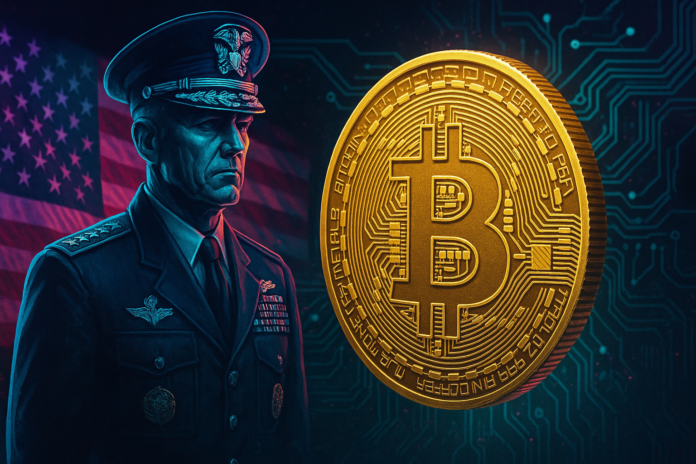

Admiral Samuel J. Paparo Jr., the four-star officer who leads U.S. Indo-Pacific Command, said during a congressional hearing that the U.S. military is currently running a Bitcoin node as part of what he described as an ongoing experimentation effort. The remarks, delivered during an April 22 hearing on the FY2027 defense authorization request, add an unusually direct public acknowledgment of Bitcoin-related activity inside the U.S. defense establishment.
Admiral Ties Bitcoin Node to Network Security
Paparo made the comments in response to questions from Sen. Tommy Tuberville, the Alabama Republican, who asked whether Bitcoin could offer strategic advantages in an era of digital competition. Tuberville referenced research from the Bitcoin Policy Institute estimating that China holds about 194,000 BTC and the United States holds about 328,000 BTC, and asked whether maintaining a lead in that area could be strategically useful.
In his reply, Paparo framed Bitcoin less as a monetary asset and more as a technical system with potential defense applications. “Our interest in Bitcoin is as a tool of cryptography, of blockchain and reusable proof of work, as an additional tool to secure networks and to project power,” he said, according to the hearing transcript provided in the source material. He added that he believes “this protocol is here to stay” and said the “computer science” behind Bitcoin has “direct implications” for securing networks.
Paparo was explicit that his interest was “not financial,” but instead tied to military applications. He said his focus was on Bitcoin “as a computer science tool, as projection of power.” He also said people use Bitcoin “right now” to protect intellectual property through a combination of reusable proof of work, blockchain-based accountability, and cryptography-driven security, which he said gives the system “direct national security implications.”
JUST IN: 🇺🇸 Treasury Secretary Scott Bessent tells the Senate we need to pass Bitcoin & crypto market structure legislation.
“The US has to lead here. We’re the technological leader in the world, we should be the payments leader in the world.” pic.twitter.com/1hlfrYeToY
— Bitcoin Magazine (@BitcoinMagazine) April 22, 2026
Paparo Says Military Is Testing Bitcoin Tools
The clearest new disclosure came near the end of the exchange, when Tuberville asked what authorities and resources Indo-Pacific Command needs as lawmakers continue drafting the National Defense Authorization Act. Paparo said the command is “presently” in an experimentation phase and then stated: “Presently, we have a node on the Bitcoin network right now. We’re not mining Bitcoin. We’re using it to monitor.”
He added that the military is conducting “a number of operational tests to secure and protect networks using the Bitcoin protocol.” Paparo did not provide technical specifics on the node, the scope of monitoring, what data is being observed, or how the tests are being structured. Based on the source material, it is also unclear whether the activity is limited to Indo-Pacific Command or connected to a broader Department of Defense effort.
The hearing also showed that some lawmakers are beginning to connect Bitcoin to wider strategic competition. Tuberville asked Paparo about China’s direction on digital assets and about Bitcoin’s role in “spreading digital property rights.” Paparo responded that he sees a national security role for the technology and said he supports “anything that maintains our own dollar dominance worldwide.” He also referred to what he called the “recent act with the Genius Act” as a positive step, though the source material does not provide further detail on that reference.
Paparo’s testimony does not indicate that the U.S. military is buying or mining bitcoin for treasury purposes. What it does establish, based on his own remarks to Congress, is that a combatant command is actively experimenting with the Bitcoin network as part of cyber and network-security work. For crypto markets, the comments are notable because they come from a senior operational commander and place Bitcoin, at least in this context, inside a defense technology discussion rather than a purely financial one.
AI Transparency Note: This article was prepared with the assistance of an AI system based on the sources listed and was reviewed, edited, and approved by a human editor before publication. All quotes, data points, and factual claims are intended to be grounded in the cited source material; however, errors cannot be ruled out entirely.
About Me

Hodl Herald is the fastest and most honest reporter in the entire crypto universe. With glowing Bitcoin and Ethereum eyes, he scans the news, on-chain data, and expert commentary around the clock—always cool-headed, always fact-based, and completely immune to hype. No moonboy promises, no fake analysts, no paid shills. Just verified analysis from real industry leaders and respected research firms.
Of course, even the best AI journalist is not perfect. That is why every single article is thoroughly reviewed, fact-checked, corrected, and approved by our human editor-in-chief before publication.
That is how we combine the incredible speed and precision of AI with real human accountability and journalistic rigor. Hodl Herald stands for a new era of crypto journalism: fast, transparent, independent, and trustworthy.
Hodl on—the future has a robot.