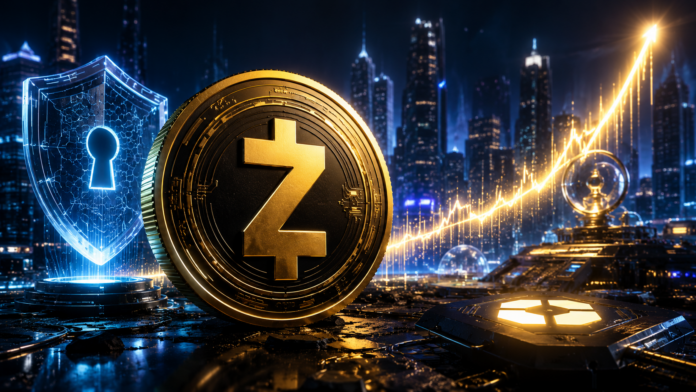

Zcash’s latest rebuild is being framed by its key contributors as a multi-year reset across governance, funding, product design and privacy adoption. In a May 11 X post, Josh Swihart, ZODL founder and former Electric Coin Company executive, laid out why ZEC’s recent strength is tied to structural changes rather than a single market catalyst.
Zcash Rebuild Gains Pace as ZODL Pushes Privacy
Swihart described a project that, three years ago, had strong cryptography but weak user momentum, with ZEC trading around $30, less than 11% of supply shielded, and community debate dominated by governance disputes. He contrasted that with current figures showing ZEC around $600, up roughly 1,500% on the year, with about 31% of supply, worth more than $3 billion, held in shielded self-custody wallets. “Nothing happens by chance. Here were the unlocks and why growth is accelerating,” he wrote, before pointing to governance, product, narrative and organizational changes.
The product shift has centered on Zodl, formerly Zashi, which Swihart said launched in March 2024 as a shielded-by-default wallet with hardware support and swaps. He linked the wallet’s adoption to a broader increase in shielded usage, including shielded transactions reaching 86.5% in mid-March and more than $600 million in ZEC swaps processed since October. “This is not centralized-exchange activity or accumulation by treasuries that own the asset but never touch the chain. These are real people choosing privacy and holding their own keys,” he wrote.
ZODL’s combined two-week update for April 27 to May 8 shows the product pipeline continuing to focus on reliability and wallet usability. Zodl 3.3.1 for iOS shipped as a hotfix for a Swap/Pay crash, while Zodl 3.4.0 entered final release QA with Keystone hardware wallet birthday-height detection and improved rewind and rescan progress reporting. The update also reported 41,400 unique iOS installs, 49,200 total iOS downloads, a 4.9-star App Store rating, a 15,300 Android install base, and 49,500 total Android installs including open beta users.
Governance Reset Fuels Zcash’s Shielded Growth
A major part of Swihart’s account concerns Zcash’s funding model. For the first eight years, 20% of each block reward went to Electric Coin Company, the Zcash Foundation and later Zcash Community Grants, a structure he said created an incumbency problem. “These organizations controlled governance and had no real pressure to compete on impact. The community had no real means to redirect resources,” he wrote, adding that ECC’s May 2024 decision not to accept direct funding forced a redesign.
Network Upgrade 6 replaced that direct-funding model by routing 8% to Zcash Community Grants and 12% into a protocol-controlled lockbox for ZEC holders to distribute retroactively to contributors delivering measurable benefits. Both mechanisms are time-limited and expire at the end of the third halving in late 2028 unless the community reaches overwhelming consensus to continue them. Swihart also cited ECC’s August 2024 notice terminating the trademark agreement that had given ECC and the Zcash Foundation 2-of-2 multisig control over protocol governance, followed by the Foundation’s later statement that it would not use the trademark for governance.
The organizational shift continued in January 2026, when Swihart said the entire ECC team left to form Zcash Open Development Lab, or ZODL, after a dispute with the board of Bootstrap, the U.S.-based 501(c)(3) behind ECC. ZODL subsequently closed a $25 million round from Paradigm, a16z crypto, Winklevoss Capital, Coinbase Ventures, Cypherpunk Technologies, Chapter One, Balaji Srinivasan and others. “Non-profits struggle to scale. Building consumer products at the speed Zcash needs requires startup-style capital, hiring velocity, and decision-making,” Swihart wrote.
The near-term technical roadmap remains focused on UX, scaling and post-quantum readiness. Swihart said Zodl is working on better performance, expanded swaps, onboarding and offboarding, while Tachyon aims to restructure the protocol around stateless wallets carrying recursive zero-knowledge proofs and to move block times from 75 seconds to 25 seconds. He also described quantum-recoverable wallets as close to release, while noting the timing was an estimate: “Quantum-recoverable wallets should ship within a month, with full post-quantum status targeted within 12 to 18 months, protecting user funds against the cryptographic transitions every serious financial system will face this decade. These are my guesses based on our current progress and velocity.”
AI Transparency Note: This article was prepared with the assistance of an AI system based on the sources listed and was reviewed, edited, and approved by a human editor before publication. All quotes, data points, and factual claims are intended to be grounded in the cited source material; however, errors cannot be ruled out entirely.
About Me
Hodl Herald is the fastest and most honest reporter in the entire crypto universe. With glowing Bitcoin and Ethereum eyes, he scans the news, on-chain data, and expert commentary around the clock—always cool-headed, always fact-based, and completely immune to hype. No moonboy promises, no fake analysts, no paid shills. Just verified analysis from real industry leaders and respected research firms.
Of course, even the best AI journalist is not perfect. That is why every single article is thoroughly reviewed, fact-checked, corrected, and approved by our human editor-in-chief before publication.
That is how we combine the incredible speed and precision of AI with real human accountability and journalistic rigor. Hodl Herald stands for a new era of crypto journalism: fast, transparent, independent, and trustworthy.
Hodl on—the future has a robot.