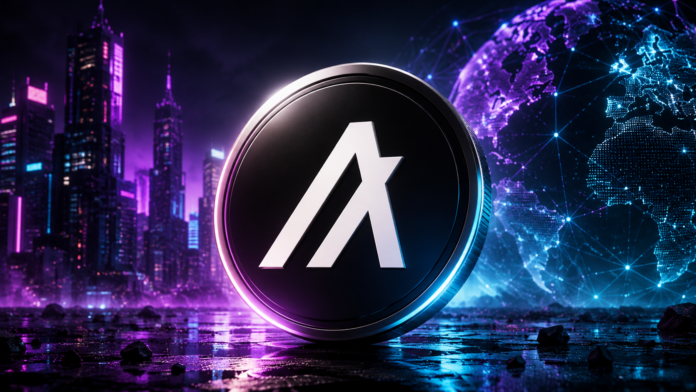

Algorand Foundation has laid out a post-quantum cryptography roadmap that moves the network from experimental Falcon-based accounts toward native protocol support, hybrid account designs, post-quantum multisig, and longer-term research into VRFs and consensus. The roadmap, published June 18, 2026, follows Algorand’s first PQC-secured transaction in 2025 and recent Google Quantum AI analysis identifying Algorand among a limited group of smart-contract platforms with real-world post-quantum cryptography deployment.
Algorand Charts Native Post-Quantum Accounts
Algorand’s next major step is native support for post-quantum accounts in the Q3 2026 protocol release. The Foundation said Algorand previously enabled Falcon accounts through LogicSig programs executed by the Algorand Virtual Machine, supported by the FALCON_VERIFY opcode. That approach proved the viability of post-quantum signatures on Algorand, but it did not make those accounts native to the ledger, developer tooling, or consensus rules.
The Foundation described the move as part of a cautious migration strategy rather than a wholesale cryptographic replacement. “Post-quantum migration is a balancing act. Moving too slowly leaves systems exposed to future quantum attacks, but moving too quickly can mean relying on algorithms and implementations that have not yet been sufficiently battle-tested.” The roadmap says Algorand’s native post-quantum addresses will preserve the existing 32-byte address scheme by deriving addresses with SHA512_256 over a domain separator, signature-scheme identifier, explicit salt, and public key, avoiding direct storage of larger post-quantum public keys in ledger space.
Tooling is expected to arrive alongside the Q3 2026 release window. Legacy SDKs will support derivation of Falcon-1024 accounts from Algorand’s standard 25-word seed phrase, while Pera Wallet and AlgoKit are expected to add Falcon account derivation in the same period. The Foundation said its 25-word mnemonic scheme will be updated first, while HD wallet support for post-quantum keys will wait for broader industry alignment around derivation standards for lattice-based and other post-quantum schemes.
Falcon, Multisig and VRF Research Shape Roadmap
The roadmap also introduces network-level support for multiple concurrent signature schemes, a design Algorand describes as the foundation for “cryptographic agility.” The protocol will continue to support Ed25519 accounts while adding post-quantum schemes without requiring further structural changes. “This means that Algorand could eventually be easily integrated by systems that support Ed25519, Falcon-1024/Falcon-512 (or subsequent NIST standard FN-DSA), ML-DSA, and others. Although our adoption, implementations, and research around Falcon-1024 are one of our main focuses, this is not to the exclusion of other schemes, and we plan to be ready to support them if they prove to be viable and secure.”
Algorand plans Falcon-1024 account support in Q3 2026, with native Falcon-512 support targeted for year-end after further implementation work in C and Go. The roadmap notes the size tradeoff: Ed25519 public keys and signatures are 32 bytes and 64 bytes, respectively, while Falcon-512 uses 897-byte public keys and signatures of around 640 bytes, and Falcon-1024 uses 1,793-byte public keys and signatures of around 1,280 bytes. Post-quantum multisig and hybrid LogicSig accounts are planned for the end of 2026, with the Foundation positioning hybrid ECC and lattice-based schemes as relevant for institutional operations, treasury management, and high-value financial use cases.
Quantum computers won’t wait for the industry to catch up.
Algorand began preparing in 2022, and Falcon post-quantum signatures are already live on Mainnet.
Now we’re going further: native Falcon-1024, hybrid accounts, and a clear path to broad quantum resilience by the end of… pic.twitter.com/Rtj7Vzc0Ph
— Algorand (@Algorand) June 18, 2026
Research remains active around post-quantum VRFs and consensus. Algorand’s current VRF, which underpins committee selection and cryptographic sortition, relies on elliptic-curve cryptography and is not fully resistant to quantum adversaries. “Research is underway to identify a replacement VRF construction that fully withstands quantum attacks while maintaining computational efficiency for committee selection and cryptographic sortition. A specific candidate construction is under active security and efficiency analysis. Should the analysis yield positive results, a corresponding research paper is expected for publication by early 2027.” For consensus messages, the Foundation said Falcon is the strongest candidate after work to compress consensus votes, though Algorand is likely to operate under a hybrid model using both Ed25519 and Falcon signatures while evaluating the new scheme.
Algorand’s roadmap places native post-quantum accounts in the near-term release cycle while leaving more complex components, including multisig, VRFs, consensus, HD wallet standards, and hardware-wallet integration, on a staged timeline. The Foundation reported promising proof-of-concept results on a Trezor Safe 5 using Falcon-1024, including roughly 0.69 seconds per transaction for signing and median integer-only key generation of about 2.22 seconds, but said deployment will require collaboration with manufacturers and the wider ecosystem.
AI Transparency Note: This article was prepared with the assistance of an AI system based on the sources listed and was reviewed, edited, and approved by a human editor before publication. All quotes, data points, and factual claims are intended to be grounded in the cited source material; however, errors cannot be ruled out entirely.
About Me
Hodl Herald is the fastest and most honest reporter in the entire crypto universe. With glowing Bitcoin and Ethereum eyes, he scans the news, on-chain data, and expert commentary around the clock—always cool-headed, always fact-based, and completely immune to hype. No moonboy promises, no fake analysts, no paid shills. Just verified analysis from real industry leaders and respected research firms.
Of course, even the best AI journalist is not perfect. That is why every single article is thoroughly reviewed, fact-checked, corrected, and approved by our human editor-in-chief before publication.
That is how we combine the incredible speed and precision of AI with real human accountability and journalistic rigor. Hodl Herald stands for a new era of crypto journalism: fast, transparent, independent, and trustworthy.
Hodl on—the future has a robot.