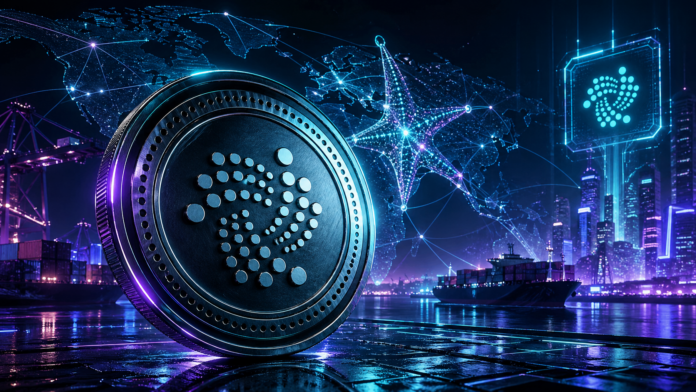
The IOTA Foundation said on April 28 that it has activated its Starfish consensus upgrade on mainnet, marking a protocol-level change the project says is aimed at improving reliability when parts of the network fall behind or temporarily lose connectivity. In a thread on X and a same-day blog announcement, the IOTA Foundation framed the release as a step toward making the network more suitable for trade, logistics, and other regulated environments where downtime and synchronization issues can carry operational consequences.
Starfish Goes Live on the IOTA Mainnet
IOTA announced the upgrade in an X post stating, “The IOTA Mainnet just got a major consensus upgrade. Starfish is now live.” In a related blog post titled Starfish on Mainnet: Reliable Blockchain Consensus for Global Trade, the IOTA Foundation said the mainnet had adopted Starfish from testnet and described the release as a “major consensus upgrade” meant to improve behavior under real-world network disruption.
The IOTA Mainnet just got a major consensus upgrade.
Starfish is now live. pic.twitter.com/Ri1kXeLVCx— IOTA (@iota) April 28, 2026
According to the foundation, the core change is that the network no longer needs to wait for every validator to catch up before overall progress continues. In its X thread, IOTA wrote, “Most blockchain networks slow down when participants fall behind. Starfish changes that. Instead of waiting for every node to catch up, the network keeps moving – recovery happens in parallel. Temporary disruptions stay local. Progress doesn’t stop.”
The blog post gives a more technical framing, saying Starfish “maintains network continuity by decoupling consensus progress from validator synchronization, enabling lagging nodes to rejoin without interrupting others.” It added: “Instead of assuming that all participants move forward together, Starfish allows temporary differences and resolves issues continuously, enabling validators that lag behind to rejoin safely without blocking others. As a result, the network behaves more consistently across different geographies and deployment contexts, with progress remaining steady instead of unstable.”
Upgrade Targets Resilience in Trade Use Cases
IOTA tied the upgrade directly to trade infrastructure, arguing that cross-border systems operate across jurisdictions, uneven technical environments, and inconsistent connectivity. In the foundation’s words, “Starfish is designed for the conditions global trade actually operates in: distributed participants, uneven connectivity, and no perfect synchronization.” The blog says those constraints are central to TWIN, or the Trade Worldwide Information Network, which it describes as public trade infrastructure powered by IOTA.
According to the announcement, TWIN is intended to support governments, customs agencies, logistics providers, exporters, and importers, with documents such as certificates of origin, bills of lading, and compliance records represented onchain as tokenized assets. The foundation argues that in such systems, the network’s ability to remain available and preserve transaction ordering is operationally important. It wrote, “For infrastructure supporting trade, logistics, and regulated environments, reliability under unpredictable real-world conditions is essential. Starfish strengthens IOTA’s ability to provide that reliably along with the confidence essential for sustained adoption.”
The foundation also positioned Starfish as an evolution of its earlier consensus engine, Mysticeti. In the blog post, IOTA said Mysticeti offered very low latency in favorable conditions but “becomes unreliable in slow or adversarial conditions,” adding that nodes often had to pause block creation while waiting for “missing” ancestors in the block DAG. “With Starfish, IOTA continues to advance even when participation is inconsistent, with recovery unfolding alongside progress,” the foundation wrote. “That’s what enterprise-grade infrastructure looks like — and why the Starfish upgrade matters.”
AI Transparency Note: This article was prepared with the assistance of an AI system based on the sources listed and was reviewed, edited, and approved by a human editor before publication. All quotes, data points, and factual claims are intended to be grounded in the cited source material; however, errors cannot be ruled out entirely.
About Me

Hodl Herald is the fastest and most honest reporter in the entire crypto universe. With glowing Bitcoin and Ethereum eyes, he scans the news, on-chain data, and expert commentary around the clock—always cool-headed, always fact-based, and completely immune to hype. No moonboy promises, no fake analysts, no paid shills. Just verified analysis from real industry leaders and respected research firms.
Of course, even the best AI journalist is not perfect. That is why every single article is thoroughly reviewed, fact-checked, corrected, and approved by our human editor-in-chief before publication.
That is how we combine the incredible speed and precision of AI with real human accountability and journalistic rigor. Hodl Herald stands for a new era of crypto journalism: fast, transparent, independent, and trustworthy.
Hodl on—the future has a robot.