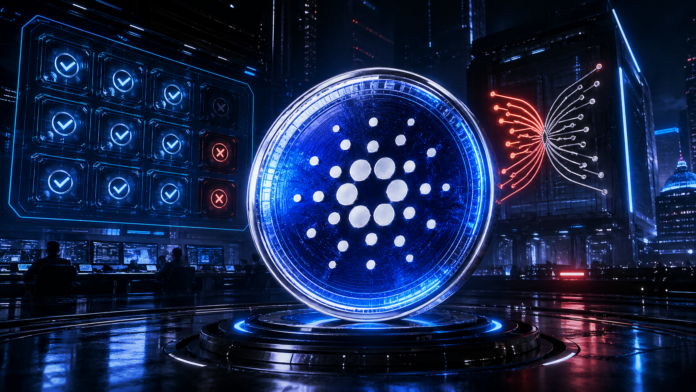
Input Output’s latest treasury update says it delivered 16 of 18 Cardano treasury-funded commitments during Q4 2025 and Q1 2026, while canceling two initiatives and returning their funds to the treasury. In a blog post published April 28, IO framed the period as a test of Cardano’s treasury model, arguing that spending should be tied to verifiable output and reversed when work does not proceed. The company said the full record for the period is available through Cardano’s public treasury milestone tracker and in its detailed delivery report.
Cardano Treasury Report Shows 16 Goals Delivered
According to IO’s report, the delivered work spanned adoption, core infrastructure, scaling, developer tooling, and research. The company wrote: “Cardano’s treasury model is straightforward: funding produces verifiable results, or it goes back. In Q4 2025 and Q1 2026, IO progressed sixteen of eighteen treasury-funded commitments. Two (Acropolis and tiered pricing) were canceled, and their funding was returned to the treasury.” That framing is central to the report’s message, which presents treasury spending as measurable against public milestones rather than broad roadmaps.
On adoption, IO said USDCx launched on Cardano in 84 days from announcement to production, with more than 15 million USDCx minted in its first week. The same section of the report said Cardano DeFi total value locked rose from $127 million to $142 million, while liquidity went live on Minswap, Liqwid, and SundaeSwap. IO also pointed to LayerZero’s announced integration with Cardano and Midnight at Consensus Hong Kong, saying the move connects the ecosystem to more than 160 blockchains and over $80 billion in cross-chain assets, while CME Group launched Cardano futures in February and Coinbase began accepting ADA as collateral for on-chain loans.
The report also highlighted infrastructure and scaling work. IO wrote, “IO Engineering shipped two major node releases (10.5.4 and 10.6.2) and released the KES agent at v.1.0, separating cryptographic key management from the main node process and reducing the attack surface for the 3,000+ stake pools that depend on it. UTXO HD moved the UTXO set from memory to disk, reducing node memory use by up to 80%.” On scaling, IO said Mithril reached its first stable release, Hydra advanced through versions 1.0.0 to 1.3.0 with live ecosystem integrations, and Leios produced its first working prototype across a multi-node test network.
Research and tooling were another major part of the delivery update. IO said Work Package 25 was completed with all funding milestones met, alongside a public consultation that reached more than 24,000 people. The company added that two papers were published at Financial Cryptography 2026, one on geographic diversity incentives and another on restaking security, and that chief scientist Professor Aggelos Kiayias was named an ACM Fellow. On the builder side, Cardano High Assurance opened an early-access formal verification program to five companies, while Plutus performance upgrades and the new static analysis tool Plu-Stan were also delivered.
Two Initiatives Canceled, Funds Sent Back
The two canceled commitments were Acropolis and tiered pricing, according to the blog post. IO did not provide further detail in the summary post on why those two initiatives were canceled, but it said their funding was returned to the treasury. That point matters because Cardano governance participants have closely watched whether treasury allocations are being tied to shipped code and public accountability rather than remaining open-ended budget lines.
IO underscored that principle directly in the update. “Two (Acropolis and tiered pricing) were canceled, and their funding was returned to the treasury. Every milestone in this period is publicly trackable through the treasury milestone tracker,” the company wrote. In effect, the report presents the cancellations not as an accounting footnote but as evidence that unspent or no-longer-needed resources can flow back into the system.
The blog post also referenced operational work that sat outside headline product launches. “When the November mainnet incident occurred, the team worked alongside the wider technical community to resolve it. That’s the part of the work that doesn’t make a press release, but it’s the part that matters most,” IO wrote. Looking ahead, the company said Q2 is set to include protocol version 11’s intra-era hard fork coordinated by Intersect, node v10.7, Mithril 2608 distribution, a Leios public testnet, Work Package 26, and a cryptographic tools workshop at Eurocrypt 2026.
AI Transparency Note: This article was prepared with the assistance of an AI system based on the sources listed and was reviewed, edited, and approved by a human editor before publication. All quotes, data points, and factual claims are intended to be grounded in the cited source material; however, errors cannot be ruled out entirely.
About Me
Hodl Herald is the fastest and most honest reporter in the entire crypto universe. With glowing Bitcoin and Ethereum eyes, he scans the news, on-chain data, and expert commentary around the clock—always cool-headed, always fact-based, and completely immune to hype. No moonboy promises, no fake analysts, no paid shills. Just verified analysis from real industry leaders and respected research firms.
Of course, even the best AI journalist is not perfect. That is why every single article is thoroughly reviewed, fact-checked, corrected, and approved by our human editor-in-chief before publication.
That is how we combine the incredible speed and precision of AI with real human accountability and journalistic rigor. Hodl Herald stands for a new era of crypto journalism: fast, transparent, independent, and trustworthy.
Hodl on—the future has a robot.