


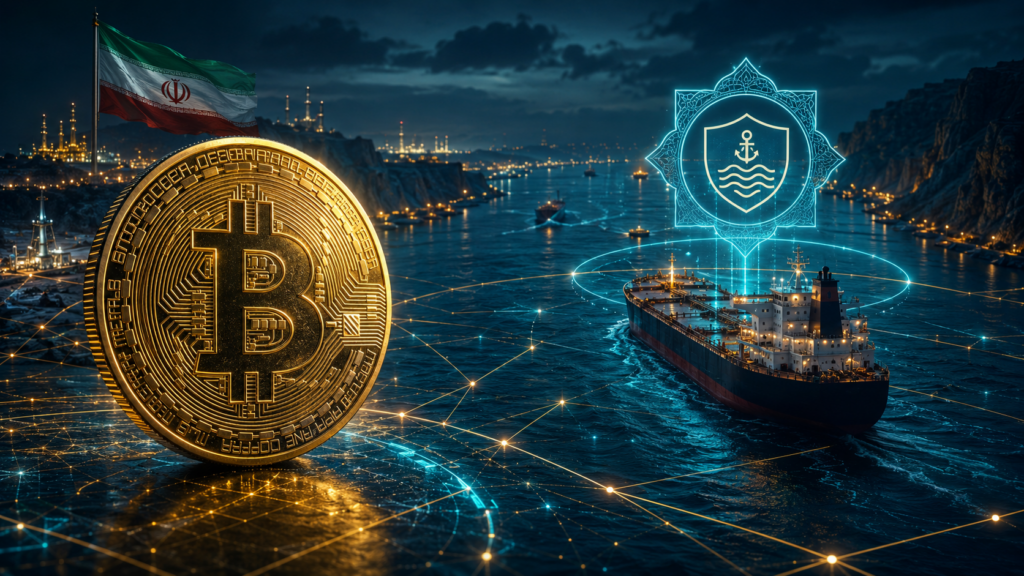
Iran has launched “Hormuz Safe,” a Bitcoin-settled insurance platform for maritime cargo moving through the Strait of Hormuz, the Persian Gulf and nearby waterways. The initiative, reported by Fars News Agency on May 17, positions BTC as the settlement asset for fast, cryptographically verifiable cargo cover tied to one of the world’s most strategically important shipping corridors.
Iran Launches Bitcoin Insurance for Hormuz Cargo
Fars News Agency reported that the Iranian insurance website for maritime cargo passing through the Strait of Hormuz has gone live under the name “Hormuz Safe.” The report said the platform is connected to a Ministry of Economy plan pursued since early Ordibehesht, the Iranian calendar month that typically begins in late April, to manage Strait of Hormuz transit through insurance mechanisms. “The ‘Hormuz Safe’ website has begun offering insurance for maritime cargo passing through the Strait of Hormuz. A document obtained by a Fars reporter shows that the Ministry of Economy has been pursuing a plan since early Ordibehesht under which management of the Strait of Hormuz would be made possible through insurance.”
The plan covers maritime insurance policies and certificates of financial responsibility, with Fars reporting that the structure could generate more than $10 billion in revenue for Iran. The revenue figure is significant because it frames the platform not merely as a compliance or risk-management tool, but as a large-scale financial infrastructure project attached to Hormuz transit. At current market levels referenced in the source material, $10 billion would be equivalent to roughly 130,000 BTC, underscoring the potential scale of Bitcoin flows if the system reaches broad adoption.
The launch also follows earlier reports that Iran had been seeking payments linked to passage through the Strait of Hormuz, with prior discussion around Chinese yuan, stablecoins and Bitcoin. Hamid Hosseini, spokesperson for the Iranian Oil Exporters’ Association, previously told the Financial Times that payments would have to be made in Bitcoin, after a preliminary ceasefire between the United States and Iran. The new Fars report narrows that uncertainty by describing a formal platform where settlement is handled in BTC rather than stablecoins or other crypto assets.
Hormuz Safe Offers BTC-Settled Maritime Cover
The platform rules cited by Fars describe the service as digital insurance for cargo moving through the Persian Gulf, the Strait of Hormuz and surrounding waterways. “The platform’s website regulations state that fast, cryptographically verifiable insurance policies are offered for cargo passing through the Persian Gulf, the Strait of Hormuz and the surrounding waterways. Payments are settled in Bitcoin, the cargo is covered from the moment of confirmation, and a signed receipt is provided to the owner.” In practical terms, the model links Bitcoin payment confirmation to the start of cargo coverage and the issuance of a signed receipt.
Materials describing Hormuz Safe present the service as “secure digital insurance for maritime cargo,” with cryptographically verifiable receipts, instant Bitcoin settlement, full cargo coverage and Strait of Hormuz transit-risk cover. While the official framing is insurance, the structure is also toll-like because payment is tied to insured passage through a controlled maritime corridor. Iranian news agency Hamshahri Online reported that fees are calculated in Iranian rials, while settlement on the platform is made in Bitcoin.
The system’s use of BTC comes after stablecoins had previously been discussed in connection with Iran-linked cross-border settlement. Notably, stablecoin use carries seizure and freezing risks. The U.S. Treasury’s April announcement revealed that $344 million in Iran-linked crypto assets had been frozen after they were identified by Tether. That context helps explain why Bitcoin’s decentralized settlement properties are central to Hormuz Safe’s design, though the source material does not state whether Iran will hold received BTC, convert it into rials, or use a combination of both.
AI Transparency Note: This article was prepared with the assistance of an AI system based on the sources listed and was reviewed, edited, and approved by a human editor before publication. All quotes, data points, and factual claims are intended to be grounded in the cited source material; however, errors cannot be ruled out entirely.