



Bitcoin has moved into a closely watched support region after falling to $62,000, with Rafael Schultze-Kraft, co-founder and Chief Technology Officer of Glassnode, outlining a valuation framework that places the market near levels where prior cycle lows have formed. In an X thread, Schultze-Kraft said BTC is now nearly 50% below its all-time high and down 24% over the past month, putting several on-chain and technical cost-basis measures back in focus for traders assessing whether the current drawdown is approaching exhaustion.
Bitcoin Tests Support as Glassnode Maps Bottom
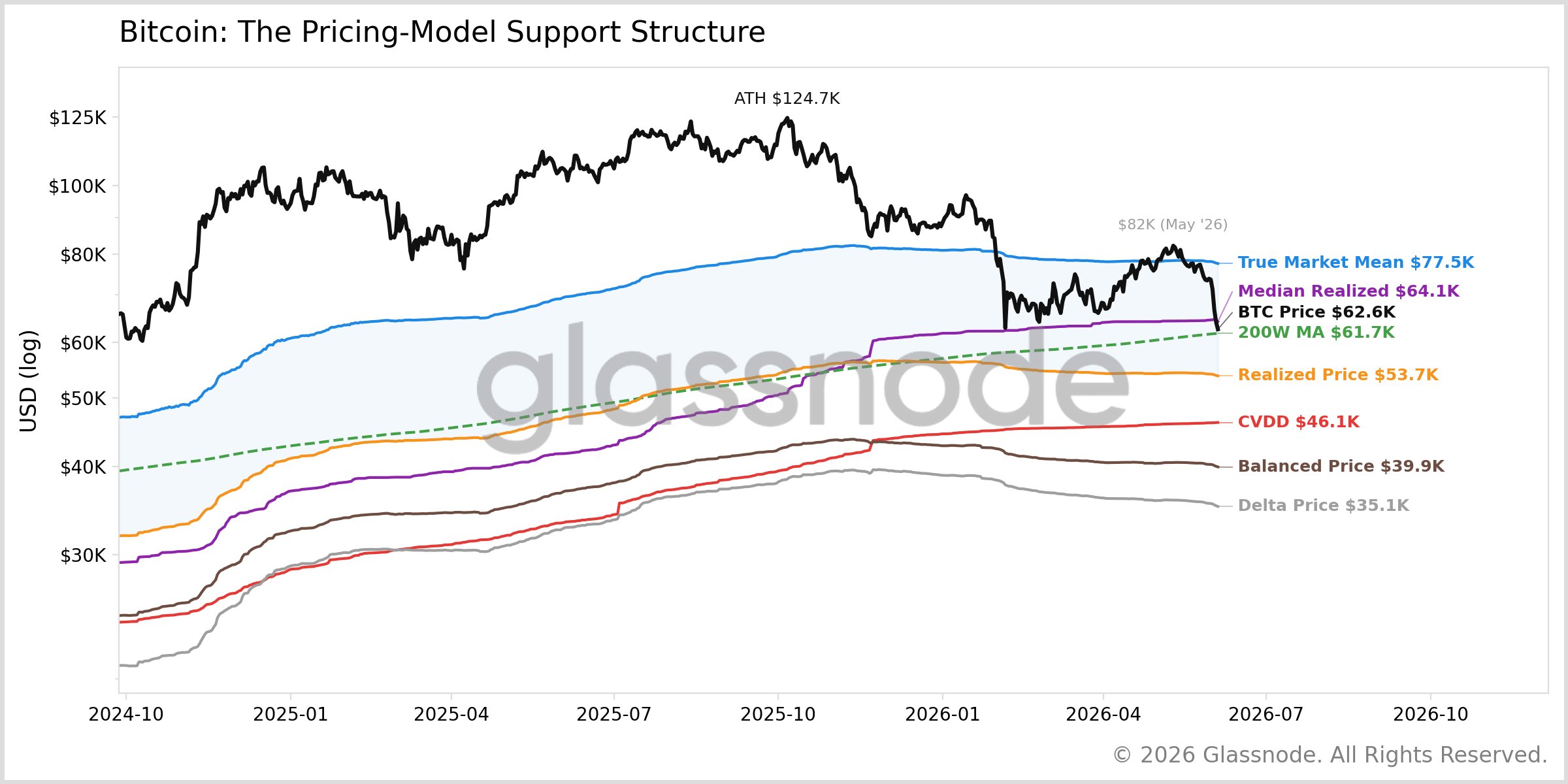
Schultze-Kraft said Bitcoin has now “worked through the upper rungs” of Glassnode’s pricing framework and entered a cluster of valuation levels historically associated with cycle floors. The immediate area includes the Median Realized Price at $64,100 and the 200-week moving average at $61,700, placing spot price directly inside a zone that market participants often treat as a dividing line between ordinary correction and deeper capitulation.
“BTC has dipped below the median holder’s breakeven level for the first time since Dec 2022. It now sits within a broader support cluster: Median Realized Price at $64.1K, and the 200WMA at $61.7K. Only ~7% of Bitcoin’s history has been spent below this Median MVRV level,” Schultze-Kraft wrote.
Below that first support shelf, he mapped a deeper cost-basis ladder that includes Realized Price near $54,000, CVDD around $46,000, Balanced Price around $40,000, and Delta Price around $35,000. “Every prior cycle low wicked into this band and recovered,” he wrote, while also emphasizing that the models do not carry equal weight in identifying bottoms. “Across prior lows, BTC bottomed within a 1.05–1.18x range of CVDD – the most precise anchor in this set. The higher valuation lines were often pierced, CVDD is where the bottom has repeatedly clustered.”

Key Cost-Basis Levels Frame BTC’s Next Move
On the current framework, Schultze-Kraft identified the higher-probability bottom zone as the area between CVDD and Realized Price, or roughly $46,000 to $54,000. He placed a more severe “capitulation tail” between Balanced Price and Delta Price, around $35,000 to $40,000, noting that this deeper range has appeared on fewer than 3% of Bitcoin trading days.
“One important caveat: cycle drawdowns have been getting shallower. Prior lows fell ~85%, ~84%, and ~77%. This cycle is ~50% below ATH so far,” Schultze-Kraft wrote. “That maturation does not rule out a deeper capitulation tail, but argues the higher-probability low sits closer to the upper zone.”
For any recovery attempt, the first major area to reclaim sits well above current price. Schultze-Kraft pointed to $75,000 to $79,000, where the short-term holder cost basis, True Market Mean, and 200-day moving average converge, saying a move that turns that cluster back into support would be an initial sign of repair. He added that the larger tests would come near the 50-week moving average around $93,000 and then at the prior all-time high, while cautioning that the framework is not a definitive bottom call: “This is a prediction, and I don’t know where the bottom is. Bottoms are not known in advance – they can only be framed in zones, probabilities, and levels that tell you when the setup is changing.”
For now, Glassnode’s framework places Bitcoin at the edge of a historically important support region, with $61,700 to $64,100 marking the current battleground and $46,000 to $54,000 forming the deeper high-conviction zone identified by Schultze-Kraft. The analysis leaves room for further downside, but it also defines the levels traders will likely watch for evidence that the drawdown is stabilizing or that broader market repair has begun.
AI Transparency Note: This article was prepared with the assistance of an AI system based on the sources listed and was reviewed, edited, and approved by a human editor before publication. All quotes, data points, and factual claims are intended to be grounded in the cited source material; however, errors cannot be ruled out entirely.