


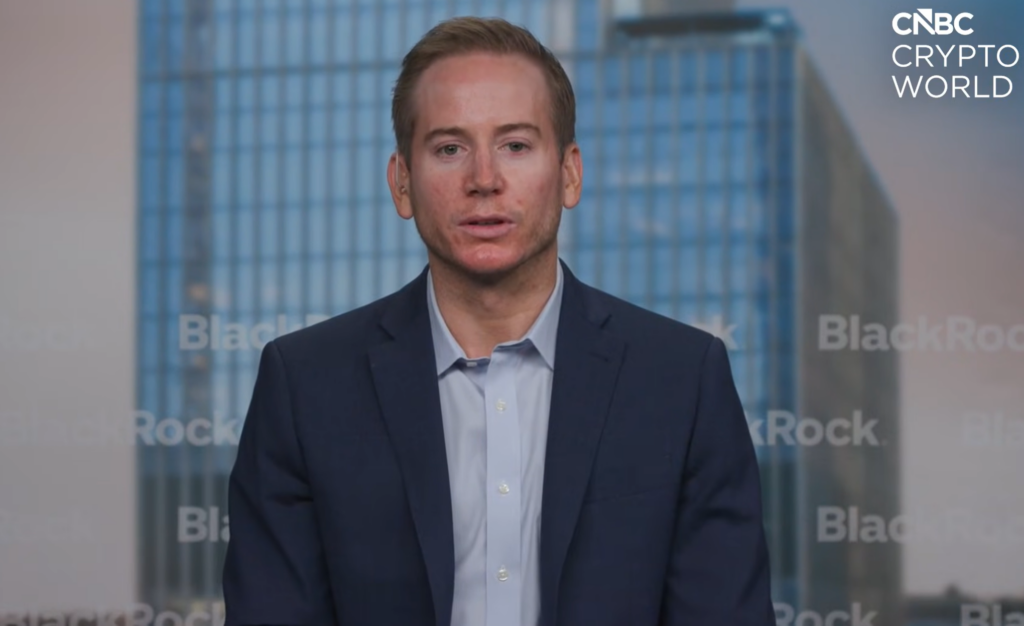
BlackRock says adding staking to an Ethereum ETF brings the product much closer to what spot Bitcoin ETFs achieved for mainstream investors: simple access wrapped in a familiar fund structure, but with more of the asset’s native economics preserved. In a March 13 CNBC Crypto World interview, BlackRock’s Robert Mitchnick argued that a staked ether ETF could sharpen Ethereum’s institutional case at a time when fund flows are showing persistent demand for regulated crypto exposure.
Why Staking Could Complete Ether’s ETF Case
Mitchnick said staking yield addresses a gap that existed in the first wave of ether exchange-traded products. “In some respects, we think about what the ETPs did for Bitcoin. That was pretty close to a silver bullet for a lot of investors in terms of being able to access Bitcoin in a super convenient, turnkey, accessible, low-cost way,” he said. “It wasn’t quite the same for the original ETPs and ether because you didn’t have the staking yield capture as part of it.”
That distinction matters because BlackRock does not frame ether the way it frames bitcoin. Mitchnick described bitcoin as an “emerging monetary alternative” with digital gold characteristics, while calling Ethereum “very clearly a technology-centric bet around blockchain innovation and the various use cases of Ether and digital assets.” In his telling, that means ETH is still likely to be assessed more like a tech or venture-style allocation than a core macro hedge, but staking makes the package more compelling for investors weighing whether the exposure belongs in a portfolio at all.
He pointed to the early asset-gathering success of ether ETPs as evidence that demand already exists even without yield. Mitchnick noted that ETH was “the third fastest ETF in history to reach 10 billion in AUM after IBIT and FBTC,” but said those products still carried “this limitation.” With staking built in, he said, ether becomes “much closer” to the Bitcoin ETF template that worked so well: a straightforward exposure vehicle that is easier for allocators to own through traditional rails.
BlackRock Sees Long-Term Demand Beyond Bitcoin
On flows, Mitchnick pushed back on the idea that crypto ETFs are dominated by fast money. He said there has been “confusion” in some corners of the market about the investor base, arguing that ETF demand has proven far more durable than many expected. Using IBIT as the example, he said bitcoin was down “almost 50%” from its October all-time high, yet “the flows in IBIT on a year-to-date basis are actually slightly positive,” suggesting ETF holders have generally taken a steadier, longer-term view than traders on exchanges or offshore leveraged venues.
He broke down that demand further by saying retail investors have actually been among the more patient buyers and have tended to buy dips. The main source of shorter-term flow behavior, he said, comes from the roughly 10% of demand tied to hedge funds running basis trades by going long the ETF and short futures. Those positions can amplify inflows when basis widens and reverse when it compresses, but Mitchnick stressed that the other “90 plus percent” of the base, including advisors and institutions, has been on a “steady” accumulation path.
That backdrop shapes how BlackRock is thinking about crypto exposure beyond bitcoin. Mitchnick said bitcoin remains the clear leader at roughly 60% of total market share, with ether the clear number two in the “low teens,” while the next assets sit far lower at around 3% to 4%. BlackRock is seeing “overwhelmingly” the most interest in those top two assets, though he acknowledged smaller “pockets of interest” elsewhere. For now, the firm’s posture remains selective: Mitchnick said BlackRock is “super excited” about its ether product and expects it to resonate, while also making clear that plain-vanilla vehicles like IBIT will remain central even as more complex ETF structures emerge.
BlackRock’s message is not that staking changes what Ethereum is, but that it makes ETF exposure look more complete. If bitcoin’s breakthrough came from turning a difficult asset into an easy one to own, BlackRock is betting that capturing ether’s yield inside the wrapper could do something similar for the market’s second-largest crypto asset, and deepen demand from investors already showing they are willing to hold through volatility.