



Bitcoin is beginning to show an early on-chain signal associated with past market bottoming processes, CryptoQuant contributor I. Moreno wrote in a recent market note. The signal comes from the Bitcoin UTXO Block P/L Count Ratio Model, which tracks the balance between Bitcoin UTXO blocks in profit and those in loss. Moreno stressed, however, that the reading should be viewed as evidence of a market reset in progress, not confirmation that a final bottom has already formed.
Bitcoin Flashes Early Bottoming Signal: CryptoQuant
Moreno said Bitcoin has produced what he described as its “first clear sign of a deeper market clean-up,” as profitability across the network has compressed. The model he cited compares the number of UTXO blocks sitting in profit with those sitting in loss, offering a view of how broad the market’s unrealized profit base remains beneath spot price.
“Bitcoin is starting to show the first clear sign of a deeper market clean-up. The Bitcoin UTXO Block P/L Count Ratio Model compares the amount of UTXO blocks sitting in profit versus those sitting in loss. In simple terms, it measures how broad the market’s profit base is beneath price,” Moreno wrote.

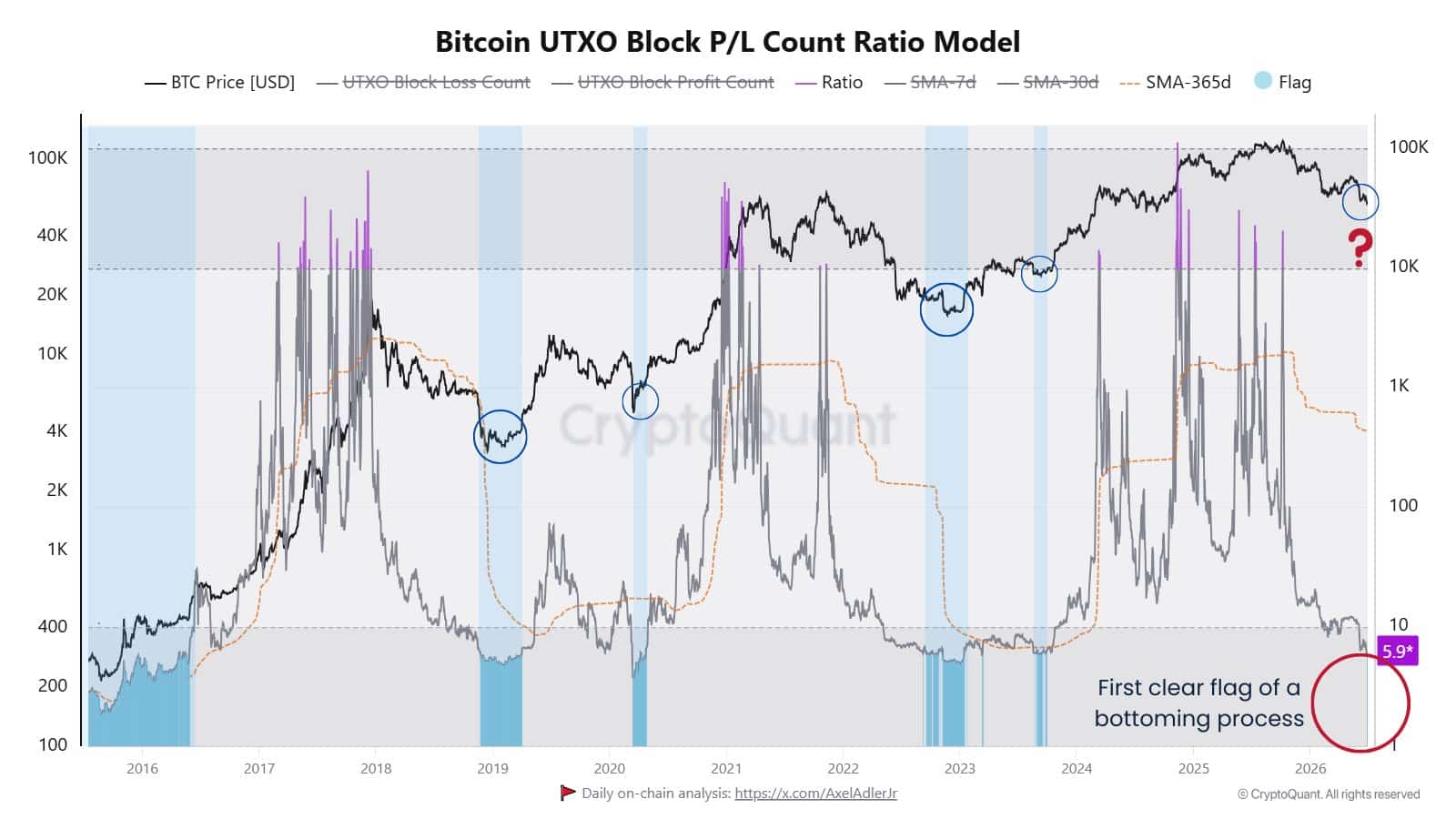
The importance of the current move, in Moreno’s view, is that the ratio has dropped into a range that has historically appeared during bottoming phases. Still, he cautioned that the signal is preliminary. “The ratio has now dropped into a zone that has historically appeared during bottoming processes, but does not mean the bottom is already in,” he wrote, framing the development as an early flag rather than a definitive reversal marker.
On-Chain Profit Ratio Points to Deeper BTC Reset
The logic behind the model is straightforward: when most UTXO blocks remain profitable, the market still carries a large base of unrealized gains, leaving room for distribution from holders sitting on profits. When that ratio falls sharply, more of the supply structure shifts into loss, suggesting that speculative excess and profit cushions are being reduced.
“When the ratio is high, most UTXO blocks remain in profit. That usually reflects a market still carrying a large amount of unrealized gains, which also means higher distribution risk. When the ratio collapses toward the lower range, the opposite happens: profitability compresses, losses become more widespread, and the market starts moving into a more advanced reset phase,” Moreno wrote.
Moreno said a stronger bottoming signal would require more than the current drop in the ratio. In particular, he pointed to the 365-day moving average, which he said still needs to decline more forcefully to show that the market’s longer-term profit structure has been reset. “For a stronger bottoming signal, the 365-day moving average still needs to fall much more aggressively. That would indicate that the long-term profit structure of the market is being properly reset, rather than simply producing a short-term oversold reading,” he wrote.
Moreno also warned that near-term rallies can occur even inside a broader reset, particularly if positioning becomes one-sided. “Short squeezes and temporary upside moves can still happen, especially if leveraged shorts become overcrowded. But those rallies should not be confused with a structural recovery unless the broader profit/loss ratio begins to rebuild sustainably,” he wrote.
His main takeaway is that Bitcoin is showing evidence of a meaningful internal clean-up, but that the process may not be complete. The note frames the current on-chain setup as an early bottoming flag rather than a final capitulation signal, with further stress potentially needed before the bearish phase is fully exhausted.
For traders and allocators, the CryptoQuant reading adds another data point to the debate over whether Bitcoin is approaching a durable cyclical low. The signal suggests that profitability has compressed into a historically important zone, but Moreno’s analysis indicates that confirmation would require a deeper reset in the longer-term profit/loss structure and sustained rebuilding in the ratio.
AI Transparency Note: This article was prepared with the assistance of an AI system based on the sources listed and was reviewed, edited, and approved by a human editor before publication. All quotes, data points, and factual claims are intended to be grounded in the cited source material; however, errors cannot be ruled out entirely.