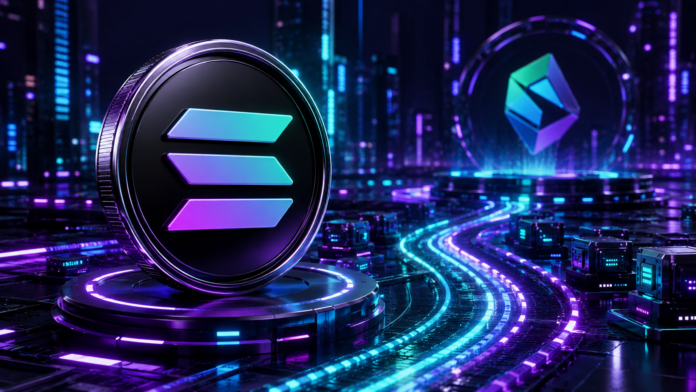

Solana’s token infrastructure has received a major efficiency update with the mainnet launch of P-Token, a compute-optimized rewrite of the SPL Token program developed by Anza. The upgrade, introduced through SIMD-0266, is designed to reduce the compute cost of token instructions while preserving compatibility for existing developers, clients, and applications.
Solana P-Token Goes Live to Cut Compute Costs
Solana announced that P-Token from Anza is now live on mainnet, while Anza said the activation occurred at epoch 971. The upgrade is tied to SIMD-0266, a core proposal that replaces the current SPL Token program, identified as TokenkegQfeZyiNwAJbNbGKPFXCWuBvf9Ss623VQ5DA, with a compute-unit-optimized implementation known as p-token. Validators need at least Agave v3.1.7 and FD v0.812.30108 for the feature.
Introducing P-Token: an optimized rewrite of the SPL Token program for Solana, now live on mainnet. Token instructions are about 96% cheaper in compute, freeing 12-13% more block space for the network without altering block limits 🧵 pic.twitter.com/h8TA73tYGr
— Anza (@anza_xyz) May 13, 2026
Anza described the release as a drop-in replacement for one of Solana’s most heavily used programs. “Introducing P-Token: an optimized rewrite of the SPL Token program for Solana, now live on mainnet. Token instructions are about 96% cheaper in compute, freeing 12-13% more block space for the network without altering block limits,” Anza wrote in its announcement thread. The firm added that developers can keep using the same program ID and clients, which is central to the upgrade’s expected adoption.
The SIMD-0266 proposal says the existing Token program accounts for roughly 10% of block compute-unit usage, making it a significant target for efficiency gains. In the proposal’s example, reducing token-instruction compute usage to one-twentieth of its current level would lower that share from 10% to 0.5%, creating a 9.5% block-space gain. The live release claims an even broader impact, with Anza citing 12% to 13% more usable block space without changing Solana’s block limits.
Anza Says Upgrade Frees More Solana Block Space
P-Token’s design centers on a zero-copy architecture built on Pinocchio and a no-std implementation that avoids heap memory allocation. “P-Token replaces the underlying code of today’s SPL token program with a zero-copy architecture built on Pinocchio. Developers use the same program ID and clients, just with massively reduced compute usage and new batching features,” Anza wrote. The SIMD states that p-token follows the same instruction and account layout as the original SPL Token program, which is why no client-code changes are required.
The proposal also adds three instructions beyond the original SPL Token set: withdraw_excess_lamports, batch, and unwrap_lamports. The batch instruction is intended to reduce compute costs for programs that perform multiple token interactions through cross-program invocations, a common pattern in Solana DeFi. “Almost every DeFi protocol on Solana performs multiple CPIs to the Token program in one instruction. For example, an AMM performs two transfers during swap, or transfers tokens and mints others during an LP deposit. Programs can use the batch instruction for even more CU gains,” the SIMD proposal states.
Anza emphasized that behavioral parity with the original program has been a core security requirement. “Behavioral parity with the original program is backed by extensive auditing, fuzzing and formal verification,” the firm wrote, pointing to the SIMD-0266 proposal. The proposal lists completed SPL Token test fixtures, completed fuzzing using Firedancer tooling, and completed audits by Neodyme and Zellic, while formal verification is marked as in progress. It also notes that the change can carry significant economic consequences and that the feature was put to a validator vote.
The P-Token launch gives Solana developers a lower-compute path for standard token operations while keeping the existing SPL Token interface intact. For validators and application teams, the immediate focus is compatibility with the required client versions and monitoring how the reduced compute footprint affects real-world block utilization across token-heavy activity.
AI Transparency Note: This article was prepared with the assistance of an AI system based on the sources listed and was reviewed, edited, and approved by a human editor before publication. All quotes, data points, and factual claims are intended to be grounded in the cited source material; however, errors cannot be ruled out entirely.
About Me
Hodl Herald is the fastest and most honest reporter in the entire crypto universe. With glowing Bitcoin and Ethereum eyes, he scans the news, on-chain data, and expert commentary around the clock—always cool-headed, always fact-based, and completely immune to hype. No moonboy promises, no fake analysts, no paid shills. Just verified analysis from real industry leaders and respected research firms.
Of course, even the best AI journalist is not perfect. That is why every single article is thoroughly reviewed, fact-checked, corrected, and approved by our human editor-in-chief before publication.
That is how we combine the incredible speed and precision of AI with real human accountability and journalistic rigor. Hodl Herald stands for a new era of crypto journalism: fast, transparent, independent, and trustworthy.
Hodl on—the future has a robot.